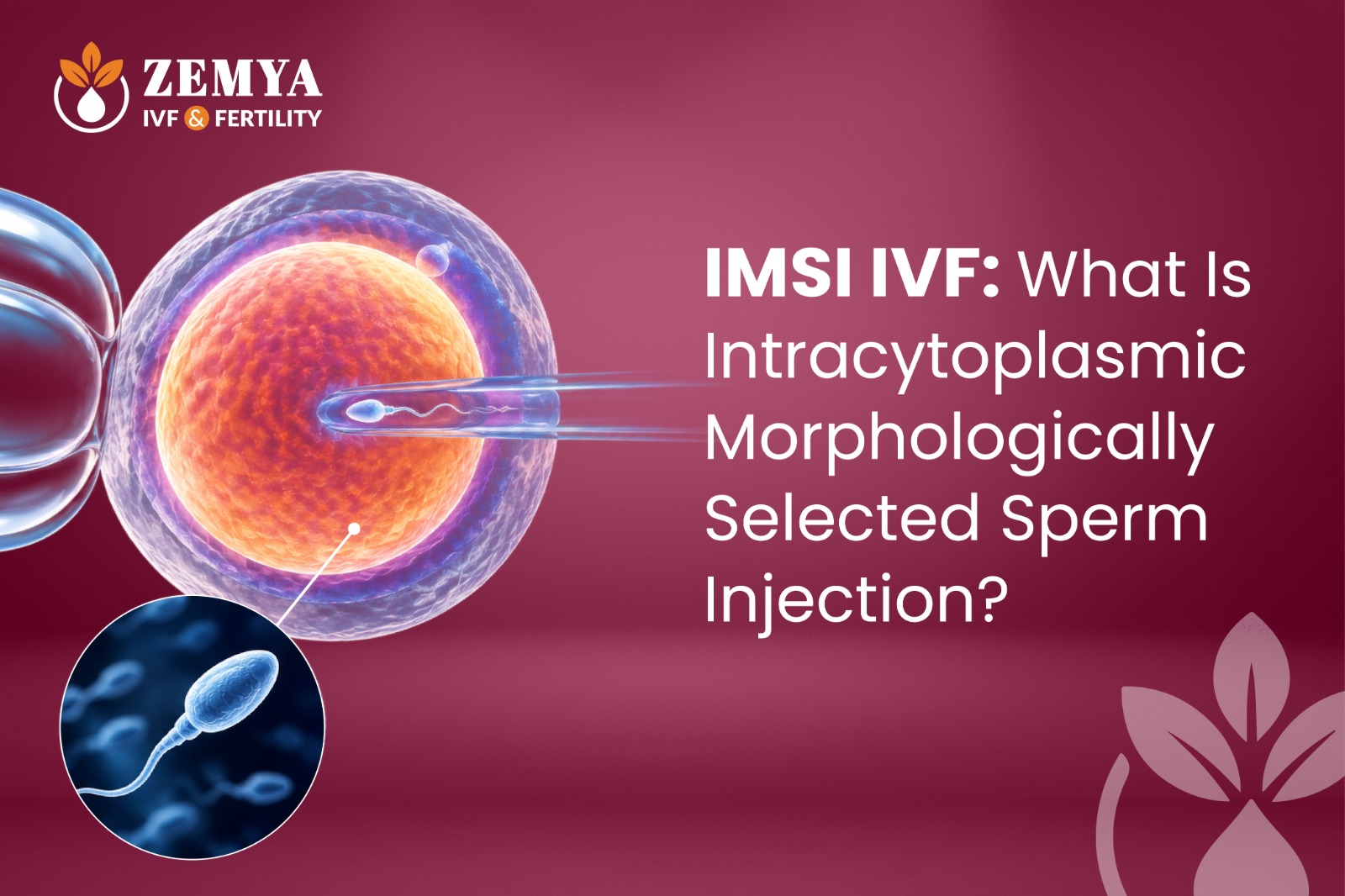
- IMSI IVF is a modern form of ICSI that uses a high-resolution microscope to examine sperm morphology. It does so in much closer detail than usual before choosing the sperm for fertilization.
- IMSI sperm selection allows for a very detailed evaluation of sperm structure. It includes sperm head morphology as well as visible vacuoles through MSOME-based evaluation.
- IMSI could be an option for cases of selected male-factor infertility and abnormal sperm morphology. This can also be done in case of previous unsuccessful IVF/ICSI treatment, but scientific data does not demonstrate a consistent benefit for all patients.
- The major difference between IMSI and ICSI is the sperm selection and the degree of magnification. In the end, both techniques involve the injection of a single sperm into an egg.
For couples who are undergoing IVF treatment, sperm selection is definitely one of the most vital parts of the fertilisation process, mainly in cases where the infertility is due to male factors. IMSI IVF, or intracytoplasmic morphologically selected sperm injection, is a more advanced version of ICSI that relies on high-resolution microscopy for a thorough check of sperm morphology before finally deciding on which sperm to inject into the egg.
IMSI provides a far more thorough procedure for examining the characteristics of each sperm cell compared to the traditional ICSI method of sperm selection, which uses only standard microscopic assessment. With the help of this more detailed inspection, embryologists can pick out minute anatomical details or structural anomalies like head defects and the presence of vacuoles
What Is IMSI in IVF?
What is IMSI in IVF? IMSI stands for Intracytoplasmic Morphologically Selected Sperm Injection. Doctors use this special technique for sperm selection during the IVF-ICSI procedure.
The concept lies in a simple fact: instead of picking up a sperm through normal microscopic magnification, the embryologist makes use of a highly magnifying optical system to scrutinize moving sperm in much greater morphological detail, so that the embryo develops from the injection of just one sperm.
This type of morphological assessment has evolved from the MSOME test (Motile Sperm Organelle Morphology Examination) method as its principle. MSOME helps to look closely not only at the sperm head but also at the sperm midpiece and some structural defects. In this way, researchers can study the presence of vacuoles and the form of the sperm thoroughly before using the sperm for injection.
How Does IMSI Work in IVF?
IMSI in IVF refers to a technique for selecting sperm using an optical microscope. One of the easiest ways to grasp why IVF works is IMSII, as an extension of ICSI.
Normally, in standard ICSI, a lab technician selects an apparently good-swimming sperm on the slide under the regular microscope and introduces a single sperm to the cytosol of a mature oocyte. Still, IMSI is a method of picking up the sperm with the best morphology and motility on the slide, first of all, through the microscope at high-power resolution and selecting them for injection.
The typical procedure is as follows:
The IVF lab carries out sperm preparation.
A high-magnification microscope examines motile sperm.
An embryologist evaluates their morphology as parameters.
The embryologist picks out morphologically well-formed sperm.
Sperm selection involves immobilising a particular sperm and microinjecting it into a mature egg.
Researchers culture and monitor fertilized gametes to determine whether embryos develop.
In other words, the primary difference is the method of selection rather than injection itself. IMSI fine-tunes ICSI, focusing mainly on morphology.
IMSI Sperm Selection and Sperm Morphology
The IMSI sperm selection technique empowers embryologists to inspect sperm at a higher magnification level than is usually the case with the conventional ICSI method. Special emphasis is placed on sperm-head contour and vacuoles.
Beyond this, scientists have shown that certain types of abnormal sperm features are linked to DNA breaks, but it is still under investigation whether the presence of different single sperm vacuoles is biologically very significant or not.
This is the point at which sperm morphology evaluation comes into play. Regular semen analysis measures sperm concentration, motility and morphology, while IMSI is a magnified view that can detect minor abnormalities that regular sperm morphology would miss when looking at a sperm in motility during egg selection.
Still, morphology alone should not be the only parameter used to predict if the resultant embryo will be normal. The use of only sperm morphology as the selection criterion would not reflect all factors that contribute to a successful IVF cycle.
IMSI vs ICSI Difference
One of the most common questions is about the IMSI vs ICSI difference.
| Feature | ICSI | IMSI |
| Fertilisation method | Single sperm injected into egg | Single selected sperm injected into egg |
| Sperm selection | Standard microscopic assessment | Higher-resolution morphological assessment |
| Morphology evaluation | Standard assessment | Detailed assessment |
| MSOME | Not routinely used | Used as part of selection |
| Sperm vacuole assessment | More limited | More detailed |
| Laboratory time | Generally shorter | Generally more time-intensive |
| Role | Established assisted fertilisation technique | More specialised sperm-selection approach |
Benefits of IMSI Over Standard ICSI
Potential benefits of IMSI over the standard ICSI. This benefit of IMSI over conventional ICSI mainly revolves around enhanced scrutiny of sperm morphology by a more meticulous means.
Thanks to the enhanced level of detail revealed via microscopy, with IMSI, embryologists may find it easier to choose a sperm cell with ideal morphology and, at the same time, eliminate those which are easily recognizable as abnormal sperm.
There are also results from the literature showing that certain patient groups experience the effect of better pregnancy-related and embryonic outcomes. For instance, a trial carried out on males with highly severe infertility showed a higher clinical pregnancy rate through IMSI than with ICSI.
Still, the findings are not homogeneous across diverse patient categories. Subsequently, a comprehensive study of randomised trials found no appreciable differences in live births or spontaneous abortions between IMSI versus ICSI, whereas non-randomized studies pointed to some advantages of IMSI
This way, IMSI is clearly not a one-size-fits-all treatment compared with ICSI that will result in a good pregnancy outcome. We should keep our cool and not say right away that IMSI is better than ICSI for all cases of IVF.
Who Needs IMSI Treatment?
In case IMSI treatment is needed for certain individuals, it can be considered in selected cases where a very thorough examination of sperm shape would make a clinical difference.
Some scenarios may be:
Extreme infertility of the man
Marked abnormalities in the sperm morphology
Extremely poor sperm shape
Difficulties in fertilisation before
Only a few ICSI cases were successful
A fertility specialist determines that a very meticulous selection of sperm is needed in certain situations.
Doctors also used IMSI to select embryos for couples who failed IVF several times after unsuccessful ICSI cycles.
However, evidence is still conflicting, and multiple IVF failures may be due to causes other than sperm morphology.
That’s why we should not think of IMSI as a solution to IVF failure only, but rather as a complement to a complete reproductive evaluation process.
IMSI and DNA Fragmentation
A further field of study is the link between sperm selection and DNA fragmentation.
Different studies show that high-resolution techniques reveal that sperm of abnormal shape are more likely to carry DNA fragmentation. Even so, researchers cannot determine if shape alone damages the DNA of the sperm, and clinicians should avoid using IMSI if they consider sperm DNA fragmentation testing a clinical necessity.
It is crucial to make the differentiation when dealing with treatment for severe male factor infertility cases, only to know whether the infertility really comes down to male factor or not. A fertility specialist can carry out various tests, including semen analysis, sperm DNA fragmentation testing, and other procedures, before recommending the best assisted reproductive technique(s).
Is IMSI Better Than ICSI?
Which is better, IMSI or ICSI? There’s no straightforward answer to this question.
IMSI is a more detailed sperm morphology analysis method, but it’s not a guarantee that every patient’s pregnancy or live-birth outcomes will improve using the technique. In fact, a multi-site randomised trial of infertility patients undergoing their first cycle of ART was conducted. Results showed that the use of IMSI was not an improvement over ICSI for implantation outcomes, clinical pregnancy rates and live births.
A systematic review has also not established a consistent live-birth advantage with IMSI in randomised trials as against ICSI. That being said, one should always evaluate the ICSI vs IMSI success rates of a method based on the patient’s disease type, sperm features, IVF cycle and lab processes that are used.
When to Choose IMSI Over ICSI?
This choice should be a shared one between the couple and a fertility expert like a specialist and embryologist. IMSI (Intracytoplasmic Morphologically selected Sperm Injection) may be appropriate when morphology (shape) of sperm is an important issue or if there is a clinical reason to select sperm much more carefully.
Meanwhile, conventional ICSI is a technique that has proved itself very well as a fertilisation method, in particular in cases of major male factor infertility.
You should definitely consider the couple’s medical history, semen parameters, previous IVF results, and the extent of the available laboratory’s expertise when making this choice.
Advanced IVF Laboratory Techniques at Zemya
At Zemya IVF & Fertility Clinics, our dedicated embryologists complement our state-of-the-art in vitro fertilisation (IVF) laboratory facilities with their skills and up-to-date laboratory premises.
The IVF laboratory at the centre has micromanipulation equipment, which allows the laboratory staff to make micro-injections of the male gametes into the egg using technology like ICSI and other special micro-insemination techniques. During IVF treatment, our embryologists will take a look at each couple’s situation and, jointly with our fertility consultants, decide which laboratory treatment is the best one.
In those cases where infertile couples go for IVF because the problems are with the male reproductive system, the fertility specialist can perform a spermiological study to find out the characteristics of the sperm, and then he will be able to explain which are the best available options for sperm selection and fertilisation procedures.
Conclusion
IMSI is a method showing how progress in reproductive medicine can provide embryologists with further insights during sperm picking. It doesn’t follow, though, that higher magnification is always better for every patient as regards getting a child via IVF. The selection of the most suitable technique depends on the fertility diagnosis of a patient, supporting evidence, expertise of the laboratory, and the course of treatment.
In case one is going for IMSI, getting it right will involve a talk with a fertility specialist to be sure whether the use of highly magnified sperm selection suits their personal IVF programme and not otherwise.