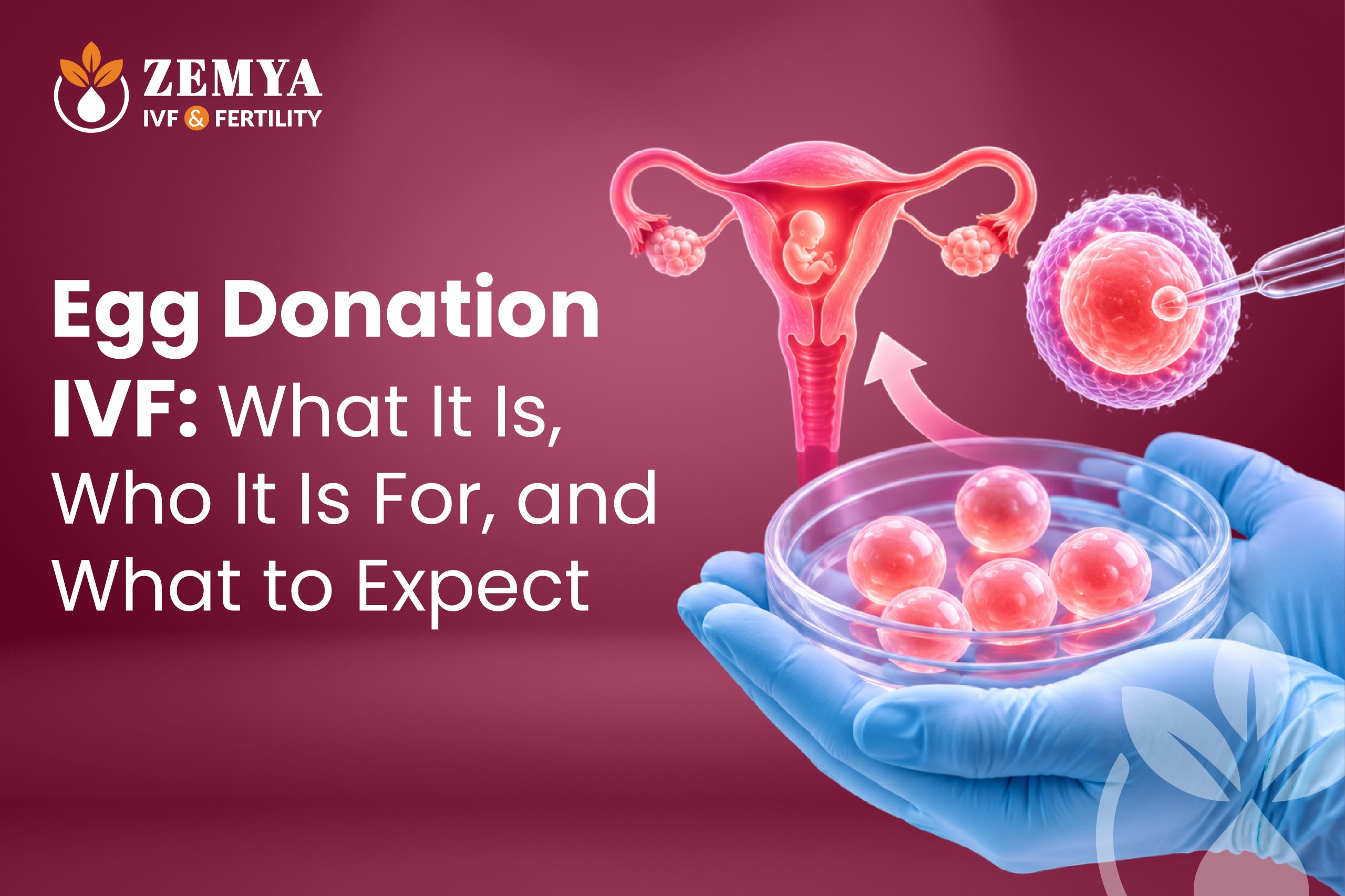
- In egg donation IVF, a donor provides eggs that are fertilised with sperm in a laboratory, and the clinic transfers the resulting embryo into the recipient’s uterus.
- Also known as donor egg IVF, this treatment is an option for individuals and couples who cannot use their own eggs or have a low chance of achieving pregnancy with them.
- Understanding egg donation IVF, what it is, who may benefit, and how the procedure works can help intended parents make informed decisions about their fertility treatment.
What Is Egg Donation IVF?
Egg donation IVF is a form of assisted reproductive technology that uses donor eggs instead of the intended mother’s own eggs. During the egg donation process, a screened egg donor undergoes ovarian stimulation to produce multiple eggs.
The medical team retrieves and fertilises these eggs using the male partner’s sperm or donor sperm through conventional fertilisation or intracytoplasmic sperm injection (ICSI).
They monitor the fertilised eggs as they develop into embryos. The team then selects an embryo for transfer into the recipient’s uterus.
Unlike conventional IVF, where the medical team retrieves the intended mother’s eggs, IVF with donor eggs involves an egg donor and a recipient.
The recipient generally takes medication for endometrial preparation to help the uterine lining support implantation.
Who Is Egg Donation IVF For?
A fertility specialist may recommend donor egg IVF when using the intended mother’s own eggs is unlikely to result in a successful pregnancy.
Common reasons include:
- Advanced maternal age: Egg quality and quantity generally decline with age, affecting fertilisation and embryo development.
- Premature ovarian failure: Also called premature ovarian insufficiency, this condition can reduce ovarian function before the usual age of menopause.
- Low ovarian reserve: A reduced number of eggs may limit the response to ovarian stimulation.
- Repeated unsuccessful IVF cycles: Donor eggs may be considered after repeated unsuccessful treatment, depending on the underlying cause.
- Cancer treatment: Chemotherapy or radiation may damage ovarian function and affect the ability to produce viable eggs.
- Genetic conditions: Individuals at risk of passing on certain genetic diseases may consider donor eggs after appropriate genetic counselling.
- Poor egg quality: When eggs repeatedly fail to fertilise or produce suitable embryos, donor egg IVF may be discussed.
The decision depends on a complete medical assessment, previous fertility treatment, ovarian reserve, medical history and personal preferences. Donor egg IVF is not necessary for everyone experiencing infertility.
Donor Egg IVF Process: Step-by-Step Procedure
The donor egg IVF process involves several stages. The exact timeline depends on donor availability, the recipient’s menstrual cycle, and whether fresh or frozen donor eggs are used.
| Step | What happens |
|---|---|
| 1. Consultation | A fertility specialist reviews medical history, previous treatment and reproductive goals. |
| 2. Donor selection | The donor is selected through an appropriate screening process. |
| 3. Ovarian stimulation | The donor receives fertility medications to produce multiple eggs. |
| 4. Egg retrieval | Mature eggs are collected through a minor surgical procedure under ultrasound guidance. |
| 5. Fertilisation | Donor eggs are fertilised with the partner’s sperm or donor sperm in the laboratory. |
| 6. Embryo development | Fertilised eggs are monitored as they develop into embryos. |
| 7. Endometrial preparation | Medication prepares the recipient’s uterine lining for implantation. |
| 8. Embryo transfer | A selected embryo is placed into the recipient’s uterus. |
| 9. Pregnancy test | A blood test is performed at the clinic-recommended time to check for pregnancy. |
1. Donor Screening and Selection
Egg donors undergo medical evaluation and screening for relevant infectious diseases and genetic conditions. Depending on applicable regulations and clinical protocols, screening may include medical and family history, physical examination and blood tests.
Intended parents may be able to review permitted donor information, including physical characteristics such as skin tone, depending on the donation arrangement and local regulations.
2. Ovarian Stimulation and Egg Retrieval
The donor undergoes ovarian stimulation using fertility drugs to encourage the ovaries to produce multiple eggs. Ultrasound scans and blood tests help monitor follicle development.
When the eggs are ready, the fertility specialist performs the egg retrieval procedure. This is generally a short, minimally invasive procedure performed with appropriate sedation or anaesthesia.
3. Fertilisation and Embryo Development
The retrieved eggs are fertilised using the partner’s sperm or donor sperm. Intracytoplasmic sperm injection may be recommended when sperm-related fertility issues are present.
The laboratory monitors the fertilised eggs as they develop. Depending on embryo development and the clinical plan, an embryo may be transferred during the appropriate cycle or frozen for future use.
4. Preparing the Recipient’s Uterus
The intended mother or recipient takes prescribed medication to prepare the endometrium. The fertility team monitors the uterine lining and coordinates the recipient’s cycle with the embryo transfer.
After the embryo transfer, a pregnancy test is performed on the date recommended by the fertility clinic.
Success Rates of Donor Egg IVF
Donor egg IVF can offer a higher chance of pregnancy for some people whose own eggs have reduced reproductive potential. However, success rates vary according to several factors.
These include:
- Donor age and egg quality.
- The number and maturity of retrieved eggs.
- Fertilisation and embryo development.
- Sperm quality and any underlying male infertility.
- The recipient’s uterine health and general medical condition.
- Whether success is measured per embryo transfer or per treatment cycle.
Because donor eggs often come from younger donors, egg quality may be more favourable than with the recipient’s own eggs in cases of advanced maternal age. However, donor egg IVF cannot guarantee pregnancy or the birth of a healthy baby. Ask your fertility specialist for clinic-specific success rates and clarification about how they are calculated.
Risks and Considerations of Egg Donation IVF
Although donor egg IVF is an established fertility treatment, it involves medical, emotional and legal considerations.
Potential medical considerations include:
- Ovarian hyperstimulation syndrome (OHSS): A complication of ovarian stimulation that can cause abdominal discomfort, bloating and, in severe cases, serious illness in the donor.
- Egg retrieval risks: Bleeding, infection, or complications related to sedation are uncommon but possible.
- Pregnancy complications: Donor egg pregnancies may carry increased risks of conditions such as high blood pressure and pre-eclampsia. Preterm birth and other pregnancy complications are also possible.
- Genetic considerations: Donor screening reduces certain risks but cannot eliminate all genetic disorders or birth defects.
- Emotional considerations: Donor conception can raise questions about genetic connections, privacy, disclosure and family relationships.
A fertility specialist can explain the potential risks, recommended monitoring and any long-term health considerations relevant to the donor and recipient.
Egg Donation IVF in India: Legal and Ethical Considerations
For people considering IVF in India, the government regulates egg donation under the Assisted Reproductive Technology (Regulation) Act, 2021, and its associated rules. Clinics must address eligibility, donor screening, consent, record-keeping, and requirements in accordance with applicable law.
Intended parents should choose a registered fertility clinic and discuss the donation process before beginning treatment. Applicable regulations govern donor arrangements, access to identifying information, and permitted practices; one should not assume an anonymous process without checking the legal requirements.
Before proceeding, ask the clinic about:
- Donor eligibility and screening.
- Written informed consent and confidentiality.
- Treatment costs and what the package includes.
- Embryo freezing and storage policies.
- Legal requirements and documentation.
- Counselling and support before and after treatment.
Conclusion: Donor Egg IVF
In conclusion, donor egg IVF is an important fertility treatment option for people who cannot produce viable eggs or whose own eggs have a low chance of resulting in pregnancy. The egg donation process includes donor screening, ovarian stimulation, egg retrieval, fertilisation, embryo development, and embryo transfer into the recipient’s uterus.
Before choosing IVF with donor eggs, intended parents should understand the medical, emotional, financial and legal considerations. A qualified fertility specialist can assess individual fertility issues, explain available fertility treatment options and help develop a personalised treatment plan.