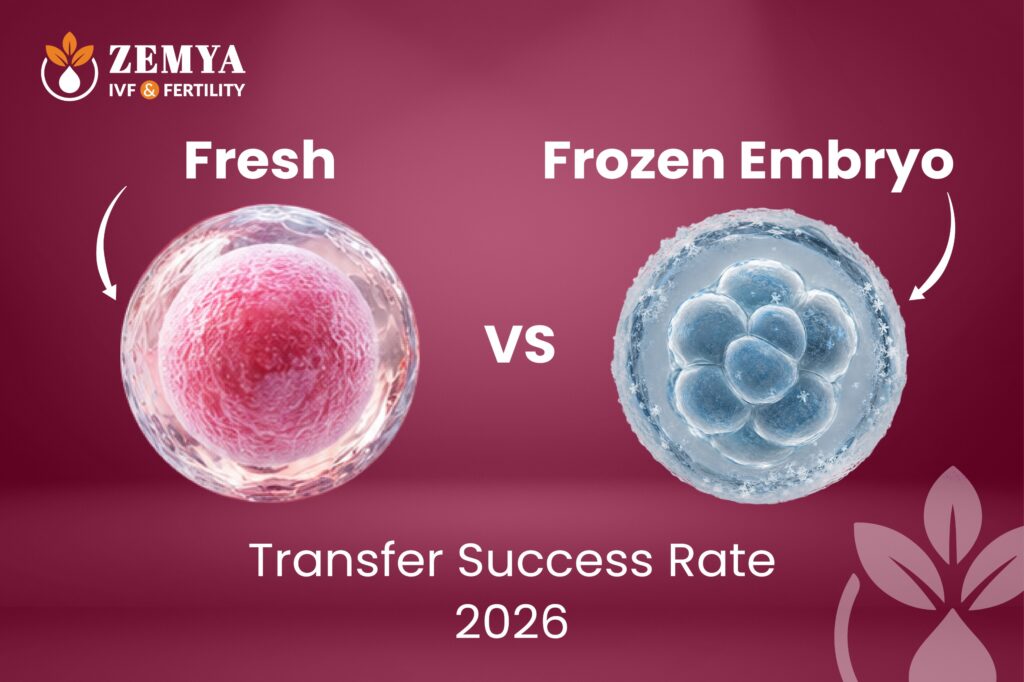
When starting the process of In Vitro Fertilization (IVF), probably the main decision points you will have with your fertility doctor are the choice between a fresh or a frozen embryo transfer. Fresh transfers were the only option used to be. On the contrary, data collected from Zemya IVF & Fertility Clinics, as well as international registries, show a clear medical shift.
The fresh vs frozen embryo transfer success rate in 2026 clearly reveals Frozen Embryo (FETs) Transfers are, in fact, competing with and, in many demographic cohorts, far surpassing fresh transfers. Understanding what distinguishes fresh from frozen embryo transfers in the clinic, how medical professionals measure each for success, and how the body changes can help you choose the best next steps with your medical team.
What Does the 2026 Registry Data Reveal?
Based on the SART CORS latest data on frozen vs fresh, there is a noticeable trend towards a freeze-all approach for IVF success rate. At present, 75% or more of IVF cases rely on frozen transfer because of the improved lab techniques and the safety factor for patients.
The statistics show that the success rates of frozen vs fresh embryo transfers differ in various ages:
| Maternal Age | Fresh Embryo Transfer Success Rate (Live Birth) | Frozen Embryo Transfer (FET) Success Rate (Live Birth) |
| Under 35 Years | 45% – 50% | 55% – 60% |
| 35 – 40 Years | 35% – 45% | 40% – 50% |
| Over 40 Years | 15% – 25% | 20% – 30% |
Notice that these figures are calculated from the average values of the clinical registry data. The exact prognosis depends on the individual case of the pathology and the quality of the laboratory.
Why Do Frozen Embryo Transfers Work Better?
This is one of the questions that many patients pose to their doctor. There are several biological and technical answers.
- Optimal Uterine Receptivity
At the very beginning of the cycle of IVF, during controlled ovarian hyperstimulation, doctors give high levels of hormone medications, which in turn lead to the development of multiple follicles. Although it is excellent for egg retrieval, it also creates a “hormonal storm” – meaning that the body elevates the levels of estrogen and progesterone significantly.
Such a hyper-stimulated state can provoke the endometrial lining to progress quite a bit, leading to different receptive characteristics of the uterus in a fresh versus a frozen cycle. The moment a fresh embryo reaches an implantation-ready stage, the window of implantation might have already shut. With a frozen embryo transfer, the body can go back to the natural state, and the lining will be in perfect harmony with the age of the embryo.
- High Embryo Survival Rates via Vitrification
Previously, a reason for failure of the frozen embryo transfer method was that the slow-freezing approach of old permitted ice formation, which because of this destroyed the fine cellular structures. Nowadays, the likelihood of embryo survival after thawing vitrification (an ultra-rapid and so-called flash-freezing technique) goes beyond 95% to 98%. The thawed embryo retrieved after cryopreservation is, for all practical purposes, the same as a freshly developed one in its potential for viability.
Advanced Protocols: Day 5 Blastocysts & Genetic Testing
The stage at which the embryo transfer occurs will play an enormous part in the outcome. The difference between the success rate of a blastocyst day 5 embryo transfer fresh versus frozen transfer vs a day 3 embryo cleavage transfer is that the blastocyst embryo is definitely the way to go.
A day 5 embryo has already demonstrated its development capabilities in developing into a multicelled embryo. Selecting a blastocyst embryo transfer will typically provide you with an extra 5% to 10% chance of implantation success because of this natural selection process.
Another critical question that most couples want to know the answer to is: Is it possible to do PGT-A for a fresh embryo transfer? PGT-A is done to see if the embryo contains the right number of chromosomes. Since it normally takes a couple of weeks for the results to be ready, it is hard to combine a fresh transfer with PGT-A. When doing the freeze-all procedure, the embryo laboratory will have enough time to find a euploid embryo.
Special Health Considerations: PCOS and OHSS Risk
- For certain patient groups, opting for a frozen transfer is more than a choice, and it is actually necessary for safety and outcome. Would you prefer a fresh or frozen embryo transfer when it comes to PCOS?
- PCOS patients are strongly recommended to have a frozen transfer. This is mainly because women with PCOS tend to produce a very large number of oocytes after ovulation, and this puts them at a higher chance of developing OHSS if the eggs are freshly transferred right there.
OHSS risk fresh vs frozen transfer: A pregnancy in a mild OHSS situation following a fresh embryo transfer poses a huge risk since the pregnancy hormones could further the OHSS condition into severe, even life-threatening, levels. Switching to the frozen transfer is 100% effective in removing this risk since it gives the ovaries time to heal completely.”
In some cases, your doctors may decide to change the mode of transfer from a fresh to a frozen embryo, without having to start a new menstrual cycle. One of the primary causes of fresh embryo transfer failures, for example, would be if your blood work results show that your progesterone levels increase at a time when you should retrieve your eggs, or if the ultrasound picture reveals that your endometrial lining is either irregular to the point of being suspicious or very thin. Freezing your embryos would allow you to have at least some hope of a cycle of the implantation process taking place, in which your uterus will be more open to the embryo.
Logistics Comparison Timing Cost
If you would like to undergo a treatment at Zemya IVF clinic, the clinic advises you to get the general idea of the time frame, logistics, and cost of your treatment protocol.
Preparation and Timing
Patients often ask about how many days should pass between an egg retrieval and a frozen embryo transfer. A standard recommendation is waiting for at least one whole menstrual cycle, i.e., about four to six weeks, to give your hormones a chance to return to a normal level.
In the following transfer cycle, your doctor may prefer to use the natural cycle FET success rate versus the fresh procedure. The body’s natural schedule of ovulation, rather than artificial hormone replacement therapy (HRT) dictates the natural FET. Recent studies have indicated that using natural FET yields a high success rate and lowers blood pressure in the mother during pregnancy.
Cost Analysis
The clear comparison of frozen embryo transfer vs fresh costs shows that there is indeed some extra cost involved in the procedure. It includes the fees for the embryo freezing process, its storage, and, finally, the thawing and transfer process.
Nonetheless, due to the high probability of success for each separate transfer cycle, the number of full stimulation cycles required will be lower. Ultimately, this means that FET is very cost-effective in the end.
Your Path Forward with Zemya IVF & Fertility Clinics
Each case of fertility treatment varies; while doctors can consider frozen embryo transfer the 2026 golden standard for safety and efficacy of the procedure, they also find value in fresh embryos in certain cases. Zemya IVF & Fertility Clinics will offer you individually customized programs specifically designed according to your needs.
