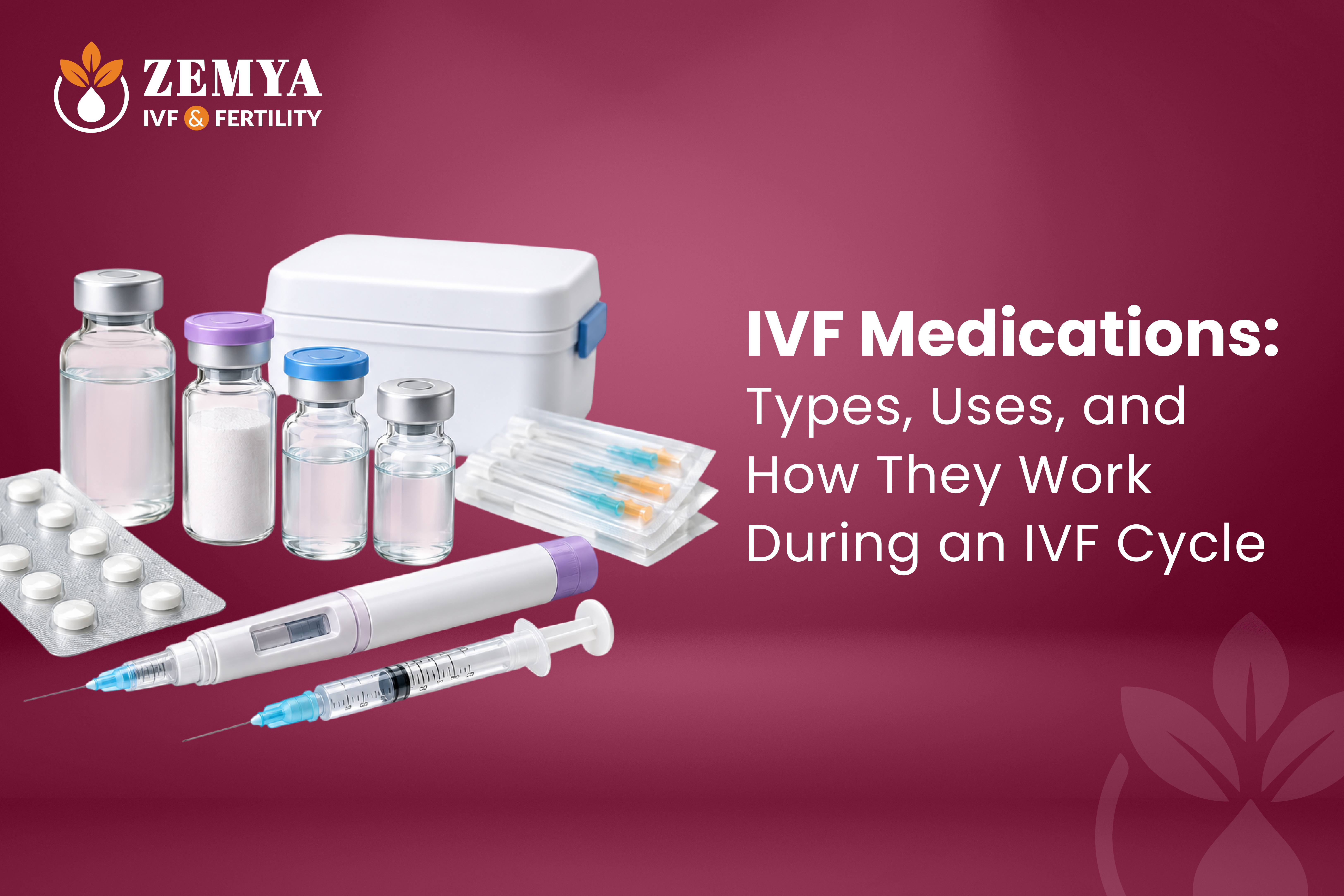
IVF medications are a component of the in vitro fertilization (IVF) procedure. Drugs are administered for the fertility specialist to be able to regulate ovulation, increase ovarian production by multiple ovarian follicles, escort the eggs to maturity, and prepare the body for transfer of the embryo.
It is not a fixed rule which medication and in what dose for each and every individual. This varies given the age, ovarian reserve, previous IVF result, ovulation disorders, and the treatment plan of the individual. Modern reproductive medicine aims at providing the best individual management, in which the medication protocols are no longer fixed.
Why Are IVF Medications Used?
Typically, at the end of a natural menstrual cycle, there will be one dominant follicle that has matured and produced one oocyte (egg). IVF programmes aim to cause the ovaries to develop many follicles, in the hope that several mature eggs will be collected at the time of egg collection.
To suppress premature ovulation, control the time of egg maturation, and support hormones after egg collection, IVF drugs.
In a controlled, perhaps “stepwise”, manner, this allows the fertility team to co-ordinate the egg collection, fertilisation and embryo transfer within the context of IVF.
Common IVF Medications
The specific medicines used can vary, but common IVF medications include the following.
1. Follicle-Stimulating Hormone (FSH)
One of the most significant drugs used during ovarian stimulation is that of FSH (follicle-stimulating hormone).
FSH stimulates the ovaries to mature several follicles. A follicle is a fluid-filled sac that contains an egg that is growing. Gonadotropin injections may include recombinant FSH or FSH from urine, and the medication dose will be titrated based on response.
Monitoring of follicle development with ultrasound and blood tests during stimulation is a possibility. A personalized dose of gonadotropins for ovarian reserve testing can help minimize the risk of a hyper response and OHSS.
2. Medicines That Prevent Premature Ovulation
Variations on the body producing a natural release of luteinizing hormone while the ovaries are being stimulated, which would then trigger ovulation before egg retrieval.
Gonadotropin-releasing hormone (GnRH) antagonist medicines are widely used in most of the IVF protocols to prevent any premature ovulation. Gonadotropin-releasing hormone (GnRH) agonists may be administered in some treatment protocols.
These must work through the hormonal mechanism of GnRH at the level of the pituitary so fertility specialists can regulate when ovulation occurs.
Regarding the use of GnRH antagonists, a reduced risk of OHSS has been reported when used instead of GnRH agonists in patients at risk of OHSS.
3. Human Chorionic Gonadotropin (hCG) Trigger
If follicle growth meets the target criteria, a trigger may be administered to enable final maturation of the eggs before Collection.
Human chorionic gonadotropin (hCG) (also called human chorionic gonadotropin HCG) may be able to use this receptor as well, and is one of the medications that may do so. Timing is crucial, as the egg retrieval is set for after the trigger.
In certain cases, like the patient’s protocol or oH SS risk, a GnarhG agonist may be used in place of an hCG trigger. (ASRM) ANRs suggest that GnRH agonist triggers be used as initial agenG as an initial approach in the reduction of moderate-to-severe OHSS.
4. Progesterone Supplementation
After ovum pick-up, some woman will be given progesterone as part of their luteal-phase support, mainly if a fresh transfer is intended.
Progesterone maintains the lining of the uterus, providing the best conditions to allow an embryo to attach.
The nature, amount, and duration of hormonal treatment also vary based on the treatment protocol used and the individual situation.
5. Estrogen and Other Medications
In some IVF treatment cycles, estrogen suppositories might be used to prepare the uterine lining, mainly for a frozen embryo transfer.
According to the patient’s medical history, diagnosis of infertility, or treatment plan, there may be other medications that could be used. Not every patient will need all of these medications.
IVF Medications and the IVF Process
In IVF, there are various stages of procedures, and at each stage the role of medications is different.
Ovarian stimulation – the fertility drugs containing FSH stimulate the development of the eggs and the growth of follicles.
Suppression of ovulation: until the search for the cause of the infertility is complete, the production of follicles may be suppressed with GnRH antagonist or other drugs.
Trigger: a trigger shot finalizes the maturation of the egg.
Egg retrieval: Mature eggs are extracted from the ovaries through a scheduled egg retrieval,
Fertilisation: It can be performed by conventional IVF or intracytoplasmic sperm injection (ICSI), as determined by the treatment program.
Embryo culture: The fertilized ovum develops to become an embryo in the laboratory.
Embryo transfer: Inserting a good embryo into the womb (this can be either a fresh embryo transfer or frozen embryo transfer in a subsequent cycle).
Pregnancy testing: A pregnancy test is carried out following embryo transfer at the time instructed by the fertility team.
Can IVF Medications Cause Side Effects?
Yes. While IVF medications can have side effects, everyone’s experience with them is different.
Some women may experience:
Bloating
Tender breasts.
The symptoms most frequently reported by women are tenderness or heaviness in the breasts.
As many as 85% of women experience breast discomfort at some stage of menstruation.
Due to the hormonal fluctuations of the menstrual cycle, it is common to experience tenderness at various times of the month.
Headache
Serious is the mood experienced with the annoyance degree of boredom.03 An and Gorth found that this mood was increased by negative factors (dislike, boredom, and activation) and decreased by positive factors (interest and liking) across valence, and now worthlessness.
The group of effects of unpleasantness (stale, dirty) is gained from the room.04so it is weaker than other effects like needs for the room and effectiveness of equipment. (C.369) Abdominal pain/discomfort. Injection-site reactions: a local reaction to the injection site known for swelling, pruritus, or pain may occur following hormone administration. Heaviness or pain in the pelvis. One important possible complication of ovarian stimulation is ovarian hyperstimulation syndrome (OHSS). In women with PCOS, elevated levels of AMH or anticipated high response can be a particular concern.
Newer IVF protocols include the use of individualized dosing of gonadotropins, use of GnRH antagonist regimens, and careful use of the trigger to minimize this complication. (ASRM) Any major symptoms, including severe abdominal pain, respiratory difficulty, ongoing vomiting, significant bloating, or rapid weight gain, should be brought to the attention of the fertility team straight away.
Do All IVF Patients Take the Same Medications?
No. IVF drugs are tailored.
Ovarian reserve testing, age, previous response to infertility treatment, levels of hormones, body morphology, pre-existing disorders, and IVF intention may be taken into account before choosing a drug protocol in line with a fertility specialist.
For example, a patient with old age, poor ovarian reserve, or previous poor response may need to be managed differently from a patient who has a high ovarian reserve or a previous hyper-response.
It is not to produce as many eggs as they possibly can. It is to produce a balanced ovarian response safely and has the highest chance of retrieving mature eggs, and in turn suitable embryos.
Are Birth Control Pills Used During IVF?
Occasionally. Sometimes birth control pills can be taken before ovarian stimulation to control ovarian response in some IVF treatment cycles and for scheduling. They are not used in all IVF cycles.
Same here; other patients may be administered other medications before stimulation, as part of their course of treatment.
What is the effect of IVF Drugs?
Once stimulation is finished and the eggs are collected, they can be fertilized outside of the human body in a laboratory. If a fresh transfer is to be performed, then the embryos are placed back into the uterus during the same treatment cycle. If not, then these can be frozen until required.
The embryos that are appropriate can be frozen and stored for later treatment. Frozen embryo transfer may be planned when the womb lining is ready.
IVF Medications at Zemya IVF & Fertility Clinics
At Zemya IVF & Fertility Clinics, IVF medications are prescribed in line with a patient’s fertility assessment and treatment protocol. The fertility team monitors ovarian response with suitable blood tests and ultrasound scans and modifies medication as necessary.
The aim at our Delhi-based fertility clinic is to individualize the treatment of women with due attention to the response and safety during the IVF cycle.
If you are thinking about IVF or have had fertility medications prescribed, talk to your fertility specialist about whether you should begin, end, or adjust your medication.