Many couples undergo various kinds of assisted reproduction treatments. However, the emotional, financial, and physical investment required can be quite draining in a very short period of time. Earlier, doctors used a single, uniform ovarian stimulation method indiscriminately for all patients using conventional IVF techniques. This was regardless of their physical peculiarities or medical histories. This way, the prescription of medication was also almost identical for all, with no room for variation or personalization.
On the contrary, modern reproductive medicine has completely turned its back on these generic programs. Currently, researchers consider the development of specific ovarian stimulation programs tailored to patients’ needs. Healthcare providers do this to achieve satisfactory clinical outcomes. Since different women’s bodies react to fertility hormones in various ways, they need to alter the treatment plan. They require this to keep the level of danger as low as possible while trying to ensure that the success is as high as possible.
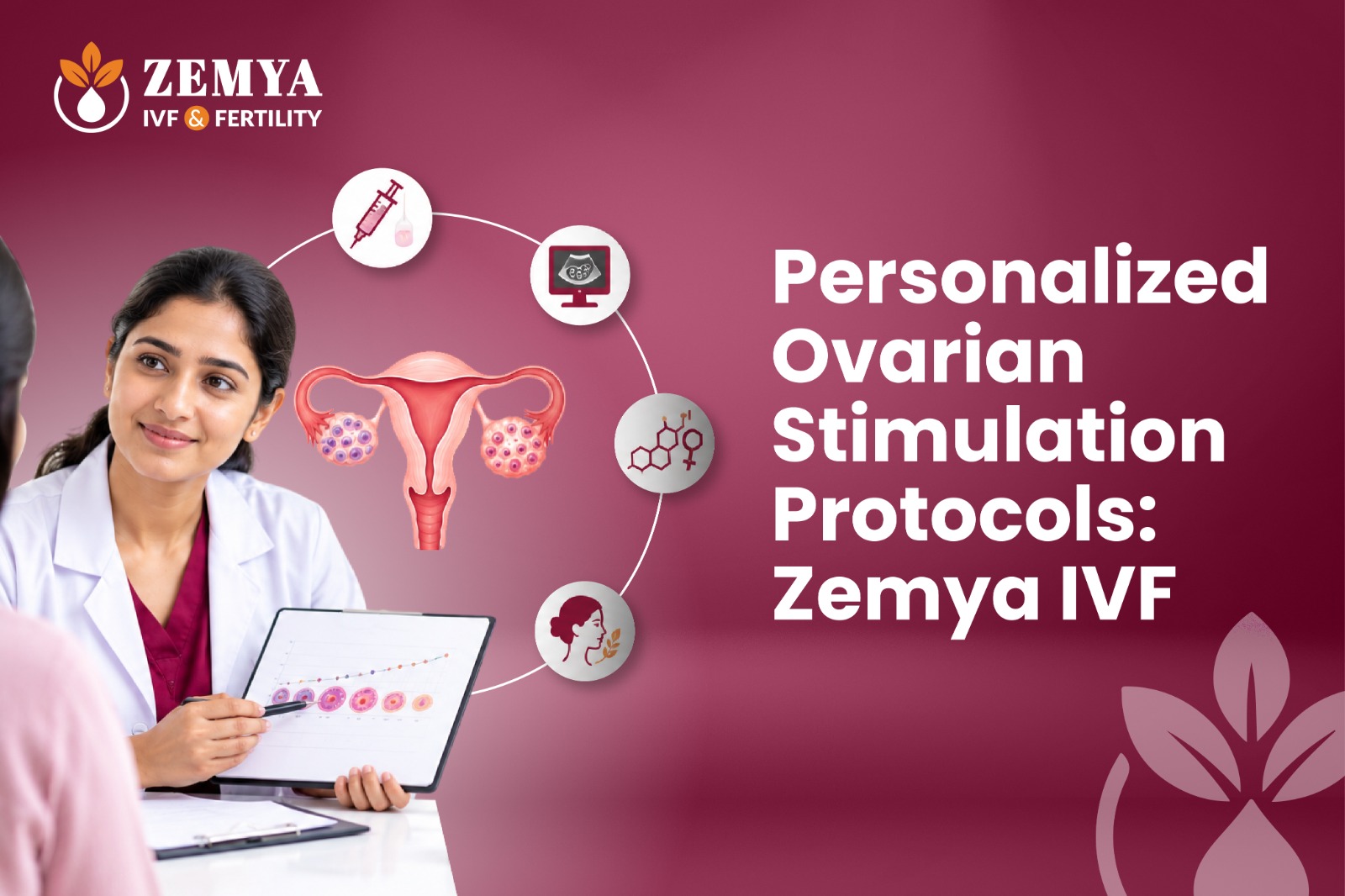
Zemya IVF & Fertility Clinics is a well-known name in South Delhi for the Best IVF centre there. Our doctors believe in an individualized approach. The mapping of the patient’s unique biological signs to a personalized regimen makes this possible. This approach allows you to collect more high-quality eggs while prioritizing your safety at all times.
Beyond Conventional Stimulation
The main objective of controlled ovarian stimulation is to safely coax the ovaries to mature several follicles at a time rather than just the one egg cell that the body releases naturally in a regular cycle.
The clinician will carefully monitor the administration of injectable gonadotrophins daily via subcutaneous injections to reach the objective.
These drugs reproduce natural signals of the body, but at really high therapeutic levels, resulting in evenly growing multiple early follicles.
Still, an unmanaged, excessive ovarian response can cause major medical issues, with the worst case being ovarian hyperstimulation syndrome (OHSS). When a woman develops severe ovarian hyperstimulation, blood vessels become hyper-permeable, fluids shift rapidly, resulting in fluid accumulation, abdominal pain, and swollen ovaries.
With the aid of individualized ovarian stimulation protocols, medical experts can determine an accurate drug dose that will enable follicles to achieve optimal development without overloading the maternal system and pushing it into a hyper-reactive situation.
Designing the Roadmap
Fertility specialists develop unique ovarian stimulation plans for each patient based on extensive evaluation of many features and medical history.
1. The Ovarian Reserve Profile
Understanding the number of potential eggs at conception is a key factor in determining the dose of the medicine. To know this, medical staff perform two basic tests:
Anti-Müllerian Hormone (AMH): The follicles in the ovary produce the anti-Müllerian hormone, which is measured to indicate how many eggs are stored within the ovary.
Antral Follicle Count (AFC): Done with the help of a high-resolution scan of the inside of the body, this check is a reliable way to count the resting follicles, which will be available at the start of the cycle.
2. Tailoring to Specific Patient Response Categories
There is good guidance on treating different kinds of patients that one can follow, e.g., the ESHRE guideline (European Society of Human Reproduction and Embryology). The patient is generally categorized into different types of cases and needs different treatment adjustments. Because of this:
| Patient Response Profile | Primary Biomarkers | Strategic Protocol Adjustments |
| High Responder / PCOS | High AMH (>3.5ng/mL), High AFC | Lower doses of gonadotropins, GnRH antagonist protocol, Lupron trigger. |
| Normal / Optimal Reserve | Normal AMH (1.5 – 3.5ng/mL) | Standard antagonist or flexible short protocol options. |
| Low Response / Poor Reserve | Low AMH (<1.0 ng/mL), Low AFC | Higher starter doses, GnRH agonist micro-dose flare, or growth hormone additions. |
In cases of low ovarian reserve, an effective way of getting the most out of the follicle growth is to be gentle at the same time. In fact, if someone administers a high dose of stimulation medicine without considering the effects, it will likely result in the follicles responding very little. A good alternative that has proved to be quite effective in this type of situation is either a well-timed short protocol or a micromolar flare protocol. In these kinds of treatments, one uses the body’s own hormone surges at their natural times to get maximum response for those follicles that are still present.
Tracking Follicular Development
After your personalized ovarian stimulation for in vitro fertilization starts, keeping track of your body’s reaction accurately is the main goal.
1. Evaluation of Baseline: Menstruation Day 1 to Day 3
The doctor performs a baseline ultrasound scan and blood tests to determine if the ovaries are at rest and if the uterine lining is thin, so no residual cyst can be found.
2. Hormone Treatment: Days 1 to 5 of Stimulation
They add the individualized medicine dose. The staff administers injections every day at the same hour to keep hormone levels constant in the blood.
3. Pituitary Suppression & Tracking: Days 6 to 10 of Stimulation
Check-ups are regularly scheduled with no less than 48-hour intervals. Physicians add a third medication to the therapy regimen to continue pituitary suppression and to stop the body from releasing the eggs before oocyte retrieval.
The Trigger & Oocyte Retrieval
The medical staff times the administration of a triggering injection so that when the best-developed follicles are of adequate size (about 18 mm), they stimulate egg maturation in the follicular fluid. The team will carry out egg pickup exactly at a 36-hour interval.
Prioritizing Patient Safety and Long-Term Success
The final objective of customizing your fertility program is to increase live births while ensuring the safety of the patients. With modification of the medication regimen depending on the individual’s needs, there is a reduction in the chances of the occurrence of complications such as ovarian torsion, which happens when the enlarged ovary twists.
Moreover, the evidence published in international literature, such as Human Reproduction through systematic reviews, indicates that the customized protocols offer better performance. The selection of the correct protocol ensures that there is a greater number of mature oocytes, thus high-quality embryos and a pregnancy.