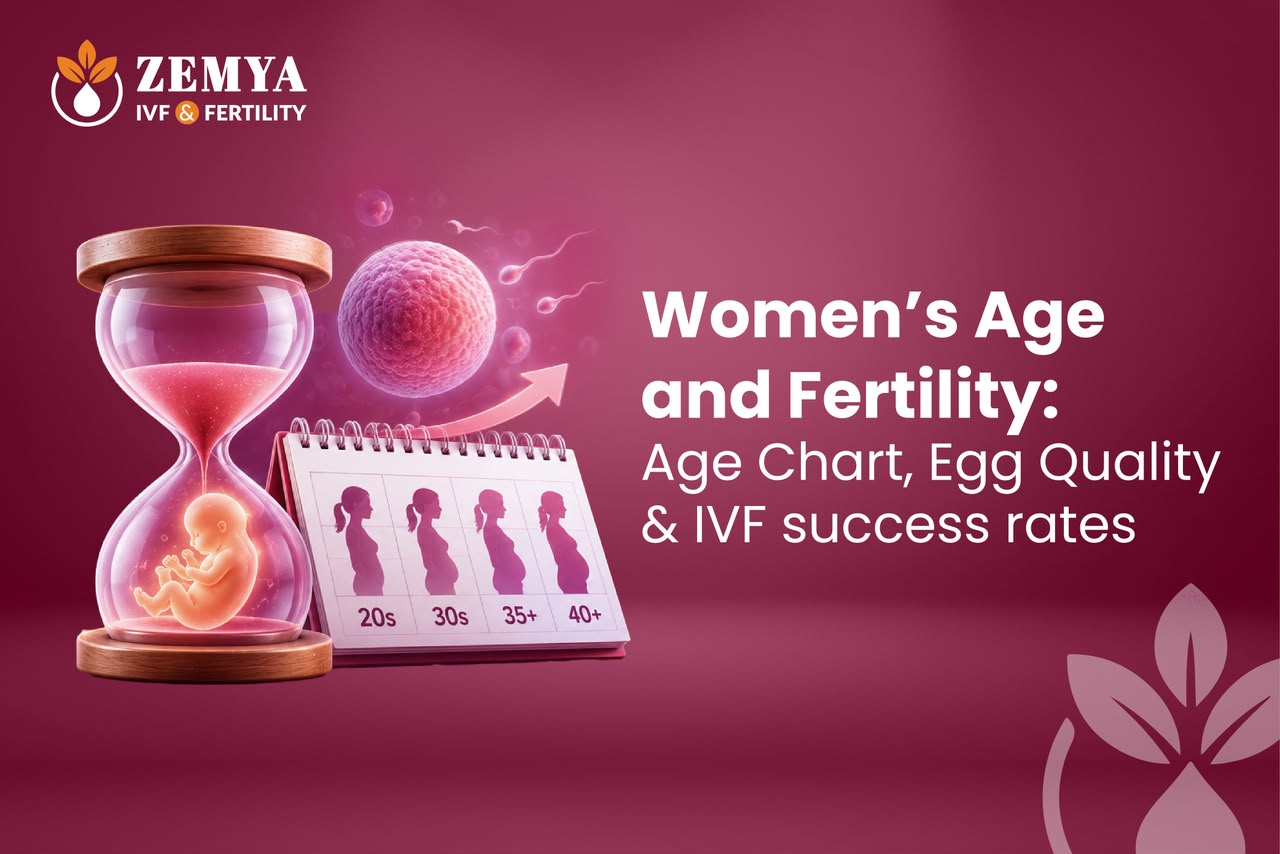
- Women’s age and fertility are closely connected. Age is one of the most important factors influencing a woman’s reproductive health, natural conception rates and chances of having a successful pregnancy.
- While many women conceive naturally in their 20s and 30s, female fertility gradually changes over time as the number and quality of eggs decline.
- Understanding how age affects fertility can help women make informed decisions about family planning, fertility testing and treatment options.
- Whether you are in your early thirties, considering delaying pregnancy or exploring egg freezing, knowing how reproductive age influences fertility can help you plan your next steps.
1. How Does Age Affect Female Fertility?
Women are born with a finite number of eggs. Unlike sperm production, which continues throughout much of a man’s life, women do not produce new eggs after birth. These eggs gradually decrease in number as a woman gets older.
Female fertility is influenced by two important factors:
- Egg quantity: The number of eggs remaining in the ovaries, often referred to as ovarian reserve.
- Egg quality: The likelihood that an egg has the normal chromosomal structure needed for healthy fertilisation and embryo development.
A gradual decline in fertility begins during the early 30s and becomes more noticeable after 35. After 40, the chances of natural conception generally decrease further, while miscarriage risk and the likelihood of chromosomal abnormalities increase.
However, age is not the only factor that influences fertility. Overall reproductive health, medical history, ovulation, fallopian tube health and male fertility also play important roles.
ACOG+2
2. Female Fertility Age Chart: Understanding Fertility at Different Ages
A female fertility age chart can help explain general changes in reproductive potential across different age groups. These are broad trends, not individual predictions.
| Women’s age group | Fertility considerations |
|---|---|
| 20–24 years | Generally high natural fertility and favourable egg quantity and quality. |
| 25–29 years | Peak reproductive years for many women, with generally favourable natural conception rates. |
| 30–34 years | Fertility may begin to decline gradually, although many women conceive naturally. |
| 35–39 years | Decline becomes more noticeable, with increasing miscarriage risk and pregnancy complications. |
| 40–44 years | Natural conception becomes less likely, and age-related infertility becomes more common. |
| 45 years and above | Natural pregnancy is uncommon, although individual circumstances vary. |
There is no single age at which every woman experiences fertility decline. Some younger women may experience fertility issues, while many older women have a healthy pregnancy with appropriate care.
3. What Happens to Egg Quantity and Quality as Women Age?
Egg quantity and egg quality are different aspects of female fertility.
Egg quantity
A woman’s ovarian reserve refers to the remaining supply of eggs in her ovaries. As age increases, the number of eggs decreases naturally. Ovarian reserve testing can provide an estimate of the remaining egg supply and help predict how the ovaries may respond to fertility medications.
Egg quality
Egg quality refers to the developmental potential of an egg. As women age, a greater proportion of eggs may have chromosomal abnormalities. This can affect fertilisation, embryo development and the likelihood of a successful pregnancy.
Poor egg quality may contribute to:
- Difficulty getting pregnant.
- Lower chances of embryo development.
- Increased miscarriage risk.
- Higher likelihood of chromosomal abnormalities.
- Reduced success rates with some fertility treatments.
Importantly, ovarian reserve tests cannot directly measure egg quality or reliably predict whether a woman will conceive naturally. Age remains an important factor when assessing reproductive potential.
4. Age-Related Fertility Changes: Why Does Getting Pregnant Become Difficult?
Several biological changes can influence fertility as women get older. These changes may affect ovulation, fertilisation and embryo development.
Common age-related fertility changes include:
- Reduced ovarian reserve: Fewer eggs remain in the ovaries.
- Changes in egg quality: The likelihood of chromosomal abnormalities increases.
- Irregular ovulation: Some women may experience changes in their menstrual cycle as they approach perimenopause.
- Increased miscarriage risk: Chromosomal abnormalities in embryos can contribute to pregnancy loss.
- Changes in reproductive health: Conditions affecting the uterus, fallopian tubes or overall health may also influence fertility.
Age-related infertility does not mean that natural conception is impossible. Many women conceive naturally in their late 30s. However, the chance of getting pregnant in each menstrual cycle generally decreases with advancing age.
5. Can Women Get Pregnant Naturally After 35 or 40?
Yes. Women can conceive naturally after 35 and, in some cases, after 40. However, natural conception rates tend to decline with age, and pregnancy may take longer to achieve.
Women aged 35 and above should consider a fertility evaluation after six months of regular unprotected intercourse without pregnancy. Women over 40 may benefit from an earlier consultation with a fertility doctor.
An earlier fertility workup may also be appropriate if you have:
- Irregular or absent menstrual periods.
- Known PCOS or endometriosis.
- Previous pelvic infections or surgery.
- Suspected blocked fallopian tubes.
- A history of recurrent miscarriage.
- Known fertility issues in either partner.
A fertility specialist can assess both partners and recommend appropriate investigations rather than relying on age alone.
6. Fertility Testing: How Is Female Fertility Evaluated?
Fertility testing helps assess ovarian reserve, ovulation and the health of the reproductive organs. A fertility doctor may recommend different tests depending on age, symptoms and medical history.
| Fertility test | What it assesses |
|---|---|
| AMH blood test | Provides an estimate of ovarian reserve. |
| Antral follicle count | Uses ultrasound to count small follicles in the ovaries. |
| FSH test | Measures follicle-stimulating hormone, usually early in the menstrual cycle. |
| Pelvic ultrasound | Evaluates the uterus, ovaries and reproductive structures. |
| Ovulation assessment | Helps determine whether ovulation is occurring. |
| HSG test | Checks whether the fallopian tubes are open. |
Other fertility awareness methods include tracking cervical mucus and basal body temperature. These methods may help identify patterns around ovulation, but they cannot diagnose infertility.
Remember: Ovarian reserve testing estimates egg quantity, not egg quality. A normal AMH level does not guarantee natural conception, and a low result does not automatically mean pregnancy is impossible.
7. How Does Age Influence IVF Success Rates?
In vitro fertilization (IVF) is one of the commonly used fertility treatments for women experiencing difficulty conceiving. During IVF treatment, eggs are collected from the ovaries, fertilised with sperm in a laboratory and allowed to develop into embryos. A selected embryo is then transferred into the uterus.
However, age continues to influence IVF success rates because egg quantity and quality affect the chances of obtaining chromosomally normal embryos.
| Age group | General IVF considerations |
|---|---|
| Below 35 | Generally more favourable outcomes using a woman’s own eggs. |
| 35–37 | Success rates may begin to decline gradually. |
| 38–40 | Reduced egg quality and quantity may affect embryo development. |
| 41–42 | IVF outcomes using own eggs are generally lower. |
| Above 42 | Success rates using own eggs are considerably lower, although individual outcomes vary. |
These are general patterns, not guaranteed outcomes or clinic-specific success rates. Actual outcomes depend on ovarian reserve, egg quality, sperm quality, embryo development, medical history and the treatment approach.
Depending on individual circumstances, fertility treatments may include:
- Ovulation-induction medications.
- Intrauterine insemination (IUI).
- IVF treatment.
- Intracytoplasmic sperm injection (ICSI).
- Genetic testing of embryos in selected cases.
- Donor egg IVF when medically appropriate.
A reproductive endocrinologist or fertility specialist can help determine which treatment is suitable.
8. Egg Freezing: An Option for Women Who Want to Delay Pregnancy
Women who wish to delay pregnancy for personal, professional or medical reasons may consider egg freezing as a fertility preservation option.
Egg freezing involves stimulating the ovaries to produce multiple mature eggs, collecting them through a procedure and preserving them using a freezing technique called vitrification.
It may be considered by:
- Women planning to delay childbearing.
- Women who want to preserve eggs at a younger age.
- Women preparing for certain cancer treatments that may affect ovarian function.
- Women with medical conditions that could affect their future fertility.
The age at which eggs are frozen is important. Younger women generally have a better chance of having eggs with favourable reproductive potential. However, egg freezing does not guarantee a future pregnancy or live birth.
9. Tips to Support Female Fertility and Reproductive Health
Although healthy habits cannot reverse natural age-related fertility decline, they can support overall reproductive health.
Consider these steps:
- Maintain a healthy weight through balanced nutrition and regular exercise.
- Eat a varied diet with adequate protein, fruits, vegetables and whole grains.
- Avoid smoking and tobacco products.
- Limit alcohol when trying to conceive.
- Discuss folic acid supplementation with your healthcare provider before pregnancy.
- Manage medical conditions such as thyroid disorders and diabetes.
- Track your menstrual cycle and understand your fertile window.
- Prioritise sleep and managing stress.
- Seek medical advice for irregular periods or persistent pelvic pain.
- Discuss medications and vaccinations during preconception planning.
A healthy lifestyle supports pregnancy preparation, but it cannot guarantee conception or eliminate age-related fertility changes.
10. When Should You Consult a Fertility Specialist?
Do not wait until fertility concerns become more difficult to address. Consider a fertility evaluation based on your age and reproductive history:
- Below 35 years: After 12 months of regular unprotected intercourse without conception.
- 35–40 years: After six months of trying to conceive.
- Above 40 years: Consider early consultation.
- At any age: Seek earlier advice if you have irregular periods, known reproductive conditions, previous fertility problems or a history of treatments that may affect ovarian function.ACOG+1
Early assessment can help identify fertility problems and provide time to consider suitable treatment options.
Conclusion
Women’s age and fertility are closely linked, particularly because egg quantity and quality decline over time. Although younger women generally have more favourable natural conception rates, pregnancy is possible at different reproductive ages.
Understanding age-related fertility changes, considering timely fertility testing and seeking guidance from a fertility doctor can help women make informed reproductive decisions. Whether you are planning natural conception, considering egg freezing or exploring IVF, individualised medical guidance can help you understand your options.